
Table of Contents
Understanding the quality standards for dolls can have a significant impact on the safety and enjoyment of playtime. Read on for some essential insights that will help you to make informed choices for your children.
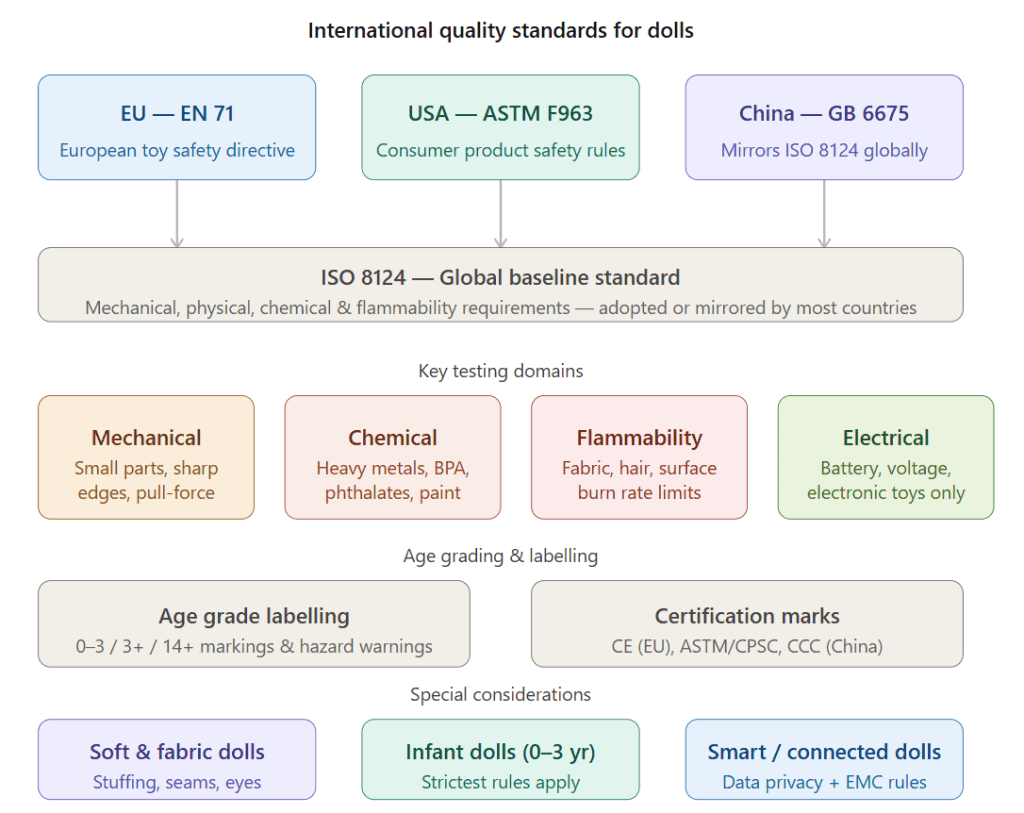
This reference guide summarizes international quality standards for dolls, including ASTM F963 (USA), EN 71 (EU), and ISO (Global), that ensure doll safety and quality.
The Importance of Doll Safety Standards
Safety standards help to prevent accidents and injuries, ensuring that children can enjoy their toys safely.
Young children, particularly infants and toddlers, tend to explore the world through touch and taste. This makes them especially vulnerable to the dangers posed by unsafe dolls.
Furthermore, compliance is critical for manufacturers because selling non-compliant products can lead to costly recalls, legal penalties, and tarnished brand reputation.
Key International Standards to Know
Toy safety regulations focus not only on mechanical hazards, but also on strict chemical and material safety requirements, which protect children from toxic substances, hazardous materials and environmental risks.
Here are some key standards with which every doll enthusiast should be familiar:
- ASTM F963: This American standard focuses on toy safety, including physical and mechanical safety requirements, flammability, and chemical restrictions.
- EN 71: Found in the European Union, this standard covers safety requirements for toys, ensuring they are non-toxic, no small parts and safe for children.
- GB 6675: China enforces its own national toy safety standard, known as GB 6675, which aligns with ISO 8124 but includes additional requirements for Chinese market regulations.
- ISO 8124: The International Organization for Standardization provides general safety guidelines applicable to a wide range of products, including dolls.
Ensuring Your Dolls Meet Quality Standard
Here’s a practical guide to buying dolls that meet quality and safety standards.
Check for the right certification label
The most important first step is looking for the certification mark relevant to your country. In Europe, look for the CE mark on the packaging — this indicates the manufacturer has declared conformity with the EU Toy Safety Directive (EN 71). In the US, products must comply with ASTM F963. reputable brands will reference this on packaging or their website. In China, look for the CCC mark. These marks are your baseline assurance.
Match the age grade to the child
Always check the age grading label 0–3, 3+, or 14+. This is not just a suggestion; it reflects which safety tests the doll has passed. A doll graded 3+ may have small parts, longer hair, or accessories that would be hazardous for a toddler. The stricter the age grade, the more rigorous the testing the product has undergone.
Buy from reputable retailers and brands
Established toy brands and licensed retailers are far more likely to have gone through proper third-party testing. When buying online, be cautious of marketplace sellers shipping directly from overseas with no brand name, no age labelling, and prices that seem unusually low — these are the products most likely to skip compliance testing entirely.
Read the label carefully
A compliant doll’s packaging should include the manufacturer’s name and address, a CE or equivalent mark, an age grade, relevant hazard warnings (e.g. “not suitable for children under 36 months — small parts”), and country of origin. Missing or vague labelling is a red flag.
Summary
Doll safety standards are not bureaucratic overhead. Compliance protects children by reducing the risk of injury from product defects or harmful materials. For brands, it builds customer trust, enhances marketability and demonstrates a commitment to safety, thereby ensuring brand integrity.